Smart Contracts vs Solana Programs: Key Differences
Learn how EVM smart contracts and Solana programs work, where they store state, how tokens are created, and which architecture fits your application.
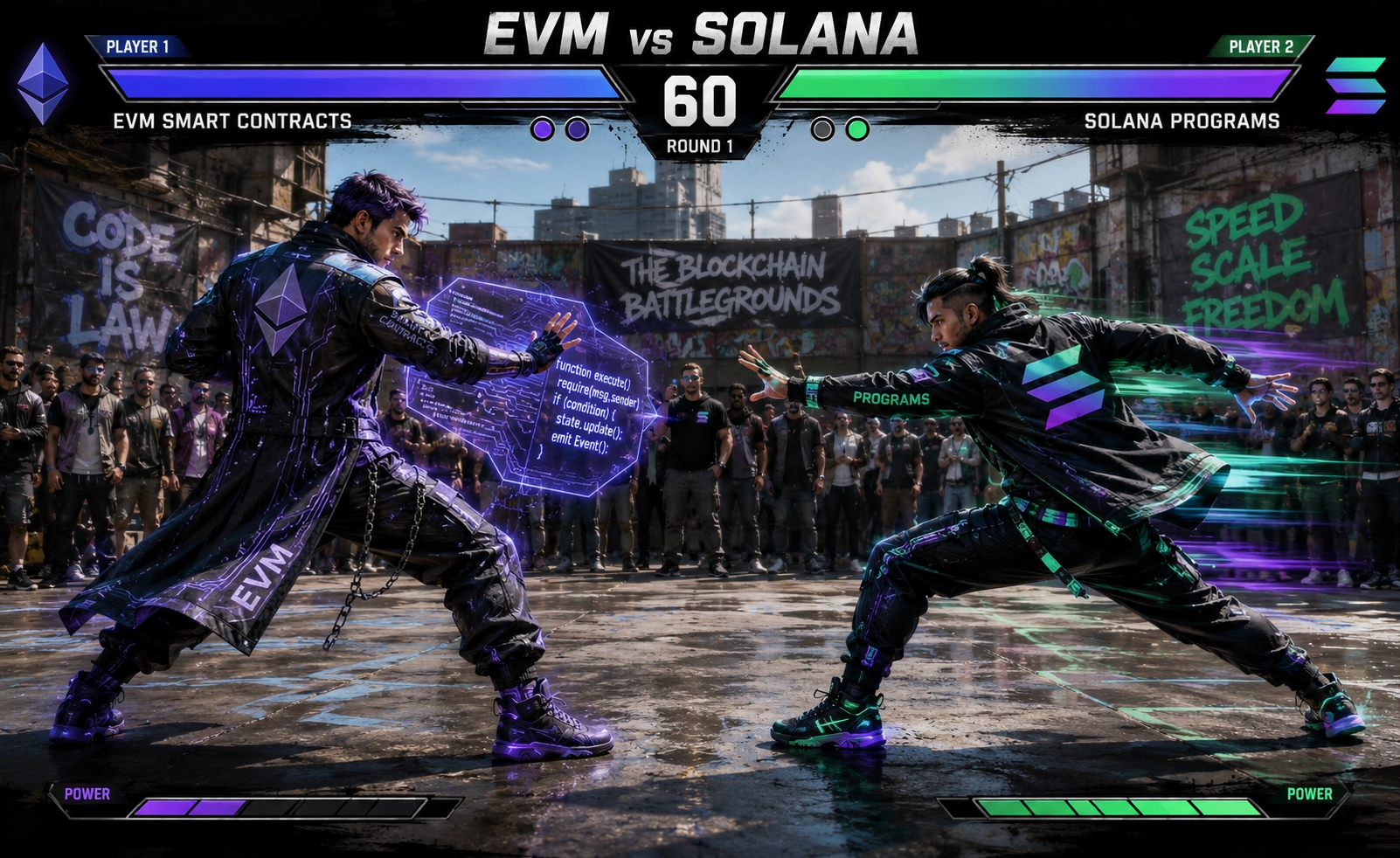
A smart contract is an on-chain program that executes deterministic rules when it receives a valid transaction or call. Ethereum and other EVM-compatible networks use the term smart contract, while Solana generally calls the equivalent executable logic a program. Both can manage assets and coordinate decentralized applications, but they organize code, state, execution, fees, and upgrades differently.
Understanding that difference matters before choosing a blockchain, designing a token, or building an application. An architecture that feels natural on Ethereum may need to be reorganized for Solana, and a standard Solana token does not require deploying a custom program in the same way that a new ERC-20 token requires deploying a new contract.
Key takeaways
- EVM smart contracts keep executable code and contract-specific storage associated with a contract account.
- Solana programs contain executable code but are stateless; mutable state lives in separate accounts supplied to each instruction.
- EVM execution is measured in gas. Solana execution is measured in compute units; transactions also pay signature fees, while new accounts require SOL for on-chain storage.
- An ERC-20 token is normally a dedicated smart contract. A standard Solana token is a Mint Account controlled by the existing Token Program or Token Extension Program.
- Both ecosystems support composable applications, but they expose different security assumptions, upgrade mechanisms, and development patterns.
What is an EVM smart contract?
An EVM smart contract is a program deployed to Ethereum or another network compatible with the Ethereum Virtual Machine. Its compiled bytecode is stored at a contract address, and its persistent storage records values such as token balances, ownership roles, protocol parameters, or application state.
Externally owned accounts, other contracts, or smart contract wallets can call the contract. The EVM executes the requested function across the network, checks whether the call follows the contract's rules, and either commits all resulting state changes or reverts them. A contract does not wake up or run by itself: it executes in response to a transaction or another contract call.
Ethereum describes a smart contract as a collection of code and data residing at a blockchain address. Contract accounts do not have private keys and cannot initiate an independent transaction; they respond when another account calls them.
How an EVM smart contract executes
The typical lifecycle is:
- A developer writes the contract, usually in Solidity or Vyper.
- A compiler converts the source code into EVM bytecode and an ABI describing the public interface.
- A wallet submits a deployment transaction and pays the network fee.
- The network creates a contract account at a new address.
- Users or other contracts call functions at that address.
- Every operation consumes gas according to its computational and storage cost.
- Successful execution updates blockchain state; failed execution reverts its changes.
The Ethereum Virtual Machine acts as a shared state machine. This common execution environment is why the same Solidity contracts and developer tooling can often be adapted to Base, BNB Smart Chain, Polygon, Avalanche, Arbitrum, Optimism, and other EVM networks.
What is a Solana program?
A Solana program is executable code stored in an on-chain account. Programs are often described as Solana's equivalent of smart contracts, but the architecture is different: the program itself is stateless. All mutable application state lives in separate data accounts that are passed to the program when an instruction executes.
Solana programs compile to Solana Bytecode Format and execute in the Solana virtual machine. Developers primarily write them in Rust, either directly with native Rust libraries or through Anchor, a framework that reduces boilerplate and generates an Interface Definition Language (IDL).
How a Solana program executes
The typical lifecycle is:
- A developer writes a program, commonly with Rust and Anchor.
- The program is compiled into an executable binary.
- Deployment creates an executable program account with a Program ID.
- The application prepares an instruction identifying the program, input data, and every account the program may read or modify.
- A transaction combines one or more instructions with the required signatures and a recent blockhash.
- The runtime loads the declared accounts and executes the program within a compute-unit budget.
- If every instruction succeeds, state changes are committed atomically; if one fails, the transaction's state changes are reverted.
The separate account model is fundamental. Solana defines an account as its basic unit of state, and only an account's owner program can modify its data. Transactions declare in advance which accounts an instruction can read, modify, or use as signers.
Smart contracts vs Solana programs
The two models solve the same broad problem running verifiable application logic on a blockchain but make different architectural choices.
Neither model is universally better. The right choice depends on existing integrations, wallet support, execution requirements, team expertise, liquidity, security assumptions, and the way the application needs to organize state.
Choose the ecosystem before choosing the implementation.
If your application needs ERC-20 compatibility and EVM integrations, compare supported networks in the EVM Token Generator. If it belongs in the Solana ecosystem, start with the Solana Token Generator and choose the token program and authority configuration that fit the project.
The most important difference: where state lives
On an EVM network, a contract account combines executable bytecode with storage assigned to that contract. A token contract, for example, maintains mappings that associate addresses with balances and allowances. Calling transfer changes values in that contract's storage.
On Solana, executable programs do not contain mutable application state. The transaction passes data accounts into the instruction, and the program validates their addresses, ownership, signer permissions, and expected structure before reading or changing them. This separation allows the same program to operate over many different accounts without deploying another copy of the program for each asset or user.
This difference changes how developers reason about an application:
- EVM development often begins with the contract and its storage layout.
- Solana development begins with instructions plus the set of accounts each instruction requires.
- EVM security reviews focus heavily on storage changes, external calls, roles, and proxy behavior.
- Solana security reviews focus heavily on account validation, signer checks, account ownership, PDA derivation, and cross-program calls.
ERC-20 tokens vs SPL and Token 2022
Token creation exposes the architectural difference particularly clearly.
Creating an ERC-20 token
ERC-20 defines a common interface for fungible tokens on EVM networks. Creating a new ERC-20 normally means deploying a new smart contract containing the token's name, symbol, supply rules, balances, allowances, transfers, and any optional behavior.
Different token designs therefore use different contract implementations. A fixed-supply token, mintable token, taxable token, or payment-oriented token may share the ERC-20 interface while implementing different permissions and mechanics. The ERC-20 standard explained covers the common functions and integration model.
Creating a token on Solana
On Solana, standard token logic already exists in shared programs. Creating a token generally creates a new Mint Account owned by one of two programs:
- The original Token Program, commonly used for standard SPL token behavior.
- The Token Extension Program, also known as Token 2022, which includes the original functionality and adds optional extensions.
The Mint Account stores properties including supply, decimals, mint authority, and freeze authority. Each holder uses a separate Token Account associated with that mint. The shared Token Program validates operations and enforces the relationship between Mint Accounts and Token Accounts.
This means a project can launch a standard Solana token without writing and deploying a custom Rust program. A custom program becomes necessary only when the application requires business logic beyond the capabilities of the selected Token Program and extensions.
Create your token without writing code.
Turn the architecture into a real token with our guided no-code tools. Launch an ERC-20 token on an EVM network, create a standard SPL Token, or choose Token 2022 for extension-based features. Configure the supply, decimals, metadata, and authorities, then deploy directly from your wallet.
Example: transferring a fungible token
The user-facing result of a token transfer looks similar in both ecosystems: one account loses units and another receives them. The work performed underneath is different.
ERC-20 transfer on an EVM network
- The wallet calls the token contract's
transferfunction. - The contract identifies the sender from the call context.
- It checks the sender's balance and validates the recipient.
- It updates its internal balance mapping.
- It emits a
Transferevent. - The wallet pays the network gas fee.
SPL token transfer on Solana
- The transaction calls the Token Program.
- It supplies the source Token Account, destination Token Account, authority, and other required accounts.
- The program verifies that the authority signed and controls the source account.
- It checks that both token accounts belong to the same mint.
- It updates the balances stored in the separate token accounts.
- The transaction pays the required Solana fees.
The standards make both flows predictable for wallets, explorers, exchanges, and applications even though their internal account models differ.
Example: an on-chain escrow
An escrow application locks assets until predefined release or refund conditions are satisfied.
On an EVM network, an escrow contract can store the depositor, recipient, amount, deadline, and status in its own storage. It can custody ETH or tokens and expose functions such as deposit, release, and refund. External calls and token approvals require careful review because they expand the attack surface.
On Solana, an escrow program operates on separate accounts representing the escrow state and token custody. Program Derived Addresses can provide deterministic addresses controlled by the program. Each instruction must validate the supplied accounts and ensure that only permitted signers can initialize, settle, or cancel the escrow.
Both versions implement the same business rule, but the Solana design makes the state accounts explicit in every instruction while the EVM design keeps state behind the contract address.
Common use cases in both ecosystems
Smart contracts and Solana programs support many of the same application categories.
Fungible tokens and stablecoins
Projects use ERC-20 contracts or Solana Token Programs for utility tokens, governance assets, reward points, payment tokens, and tokenized real-world assets. Supply policy and administrative authority matter more than the label attached to the token.
Decentralized finance
Lending, automated exchanges, derivatives, staking systems, and collateralized protocols rely on on-chain programs to enforce positions and settlement rules. These applications are highly composable but also inherit dependency, oracle, liquidity, and governance risks.
Payments and agentic commerce
Both ecosystems can support signature-based payments, subscriptions, API payments, and autonomous agent transactions. EVM applications commonly use standards such as ERC-2612 and EIP-3009, while Solana applications use signed transactions and token instructions. The x402 overview explores one payment protocol spanning both ecosystems.
DAOs and treasury management
On-chain voting, multisignature control, timelocks, and treasury programs coordinate shared assets. Governance rules still need operational safeguards because code execution cannot determine whether a proposal is economically sound.
Gaming and digital ownership
Programs can control assets, marketplaces, crafting rules, rewards, and game economies. Token ownership remains verifiable on-chain, but the usefulness of an asset can still depend on the game, its servers, intellectual property rights, and continued application support.
Credentials and tokenized access
Tokens and program-controlled accounts can represent memberships, achievements, tickets, attestations, or access rights. Privacy and revocation requirements should be designed before immutable data or identifiers are placed on-chain.
Fees and performance
EVM networks meter contract execution with gas. Every opcode has a gas cost, and the total network fee depends on the gas used and the network's fee market. Writing persistent storage is generally more expensive than reading it, and contract deployment consumes more gas than a simple transfer.
Solana meters execution in compute units. Transactions also pay signature fees and may need to fund accounts that store on-chain data. Applications can request a compute-unit limit and priority fee, while the runtime uses the accounts declared by each transaction to coordinate execution.
It is tempting to reduce the comparison to “which chain is faster or cheaper,” but that answer changes with network conditions and application design. A useful evaluation should measure the actual operation: how many accounts or storage slots it touches, how much computation it performs, which external programs it calls, and what user and liquidity ecosystem it needs.
Composability: calls and cross-program invocations
EVM contracts compose by calling other contract addresses. A DeFi transaction may call a token contract, lending protocol, price oracle, and exchange router before returning to the original contract. This produces powerful open integrations, but a failure or vulnerability in one dependency can affect the entire transaction.
Solana programs compose through Cross-Program Invocations. The calling program invokes another program and passes the accounts it needs. Because account permissions and writable state are explicit, developers must carefully verify that the intended program and accounts are used.
Interfaces make this composition easier. EVM applications publish an ABI, while Solana programs frequently publish an IDL. These JSON interfaces help explorers decode instructions and allow developers to generate clients.
Can smart contracts and Solana programs be upgraded?
“Code is immutable” is an incomplete description in both ecosystems.
An EVM contract's deployed bytecode is normally fixed at its address, but an application can use a proxy contract that delegates execution to a replaceable implementation. Upgradeability introduces an administrator or governance process that users must evaluate. A non-upgradeable contract removes that mechanism but also makes defects harder to correct.
Solana programs deployed with an upgrade authority can be updated. That authority can be transferred or removed; revoking it makes the program immutable.
Users should therefore ask who controls upgrades, which delay or multisignature protects that authority, whether changes are announced, and whether the deployed code or build can be independently verified.
Security risks and review checklist
Blockchain execution makes outcomes verifiable; it does not make application code automatically safe.
EVM security risks
- Reentrancy and unsafe external calls
- Incorrect ownership or role configuration
- Excessive token approvals
- Arithmetic or accounting errors
- Oracle manipulation
- Upgradeable proxy and storage-layout mistakes
- Unprotected initialization
- Governance and admin-key compromise
Solana security risks
- Missing signer or ownership checks
- Accepting an unexpected account or program
- Incorrect PDA seeds or bump validation
- Duplicate mutable accounts
- Unsafe Cross-Program Invocations
- Closing or reallocating the wrong account
- Exposed program upgrade authority
- Unintended mint, freeze, transfer, or metadata authority
Before interacting with either architecture, verify the network, address, permissions, upgrade model, source or build information, and exact wallet transaction. An audit reduces risk but does not guarantee safety.
Inspect before you interact.
For an EVM contract, use Contract Utility to load an ABI and review available read or write methods. The tool helps prepare an interaction; it does not certify that the contract is audited or trustworthy. For Solana, inspect the Program ID, accounts, authorities, and transaction instructions in a compatible explorer.
How to get hands-on experience without writing code
Creating a fungible token is a practical way to observe how the two architectures differ.
Try an EVM smart contract
- Open the ERC20 Token Generator.
- Select an EVM network and token template.
- Configure the name, symbol, supply, decimals, and permissions.
- Review the generated contract configuration and deployment cost.
- Deploy from your wallet, then inspect the contract address, verified source, ABI, and events.
Try a Solana token
- Open the Solana Token Generator.
- Choose SPL Token or Token 2022.
- Configure the mint, supply, decimals, metadata, and optional authorities.
- Review which authorities will remain active or be permanently revoked.
- Approve the transaction, then inspect the Mint Account and holder Token Account in Solana Explorer.
This comparison reveals the architectural difference directly: the EVM flow deploys a token contract, while the Solana flow creates accounts operated by an existing Token Program.
Choosing between EVM and Solana
Choose based on application requirements rather than a single performance metric.
An EVM network may be a better fit when the project depends on Solidity expertise, ERC standards, EVM wallets, existing EVM liquidity, or integrations that already expose contract addresses and ABIs.
Solana may be a better fit when the application is designed around Solana wallets, programs, account-based state, Token Program integrations, and transaction flows native to the Solana ecosystem.
Teams should evaluate:
- Where the target users and liquidity already exist
- Which wallets, exchanges, and protocols must integrate the asset
- Whether the team knows Solidity or Rust and Anchor
- Expected state, compute, and transaction requirements
- Required token features and authority model
- Upgrade, governance, and emergency-control requirements
- Operational tooling for monitoring and support
Multichain deployment can expand reach, but it also multiplies liquidity, bridge, security, and support responsibilities. Launching on one well-supported ecosystem is often safer than deploying everywhere without an operating plan.
Next steps
EVM smart contracts and Solana programs are two approaches to the same goal: executing transparent application rules on shared blockchain infrastructure. Their most important difference is not terminology or headline transaction speed, but how code and state are organized.
If you want to continue from theory to a real transaction:
- Create an ERC-20 smart contract
- Create an SPL or Token 2022 token
- Read Token Generator documentation
- Inspect an EVM contract interface
- Distribute ERC-20 tokens with MultiSender
Start with a test environment, verify every address and authority, and treat deployment as the beginning of the operational lifecycle rather than the end of development.